
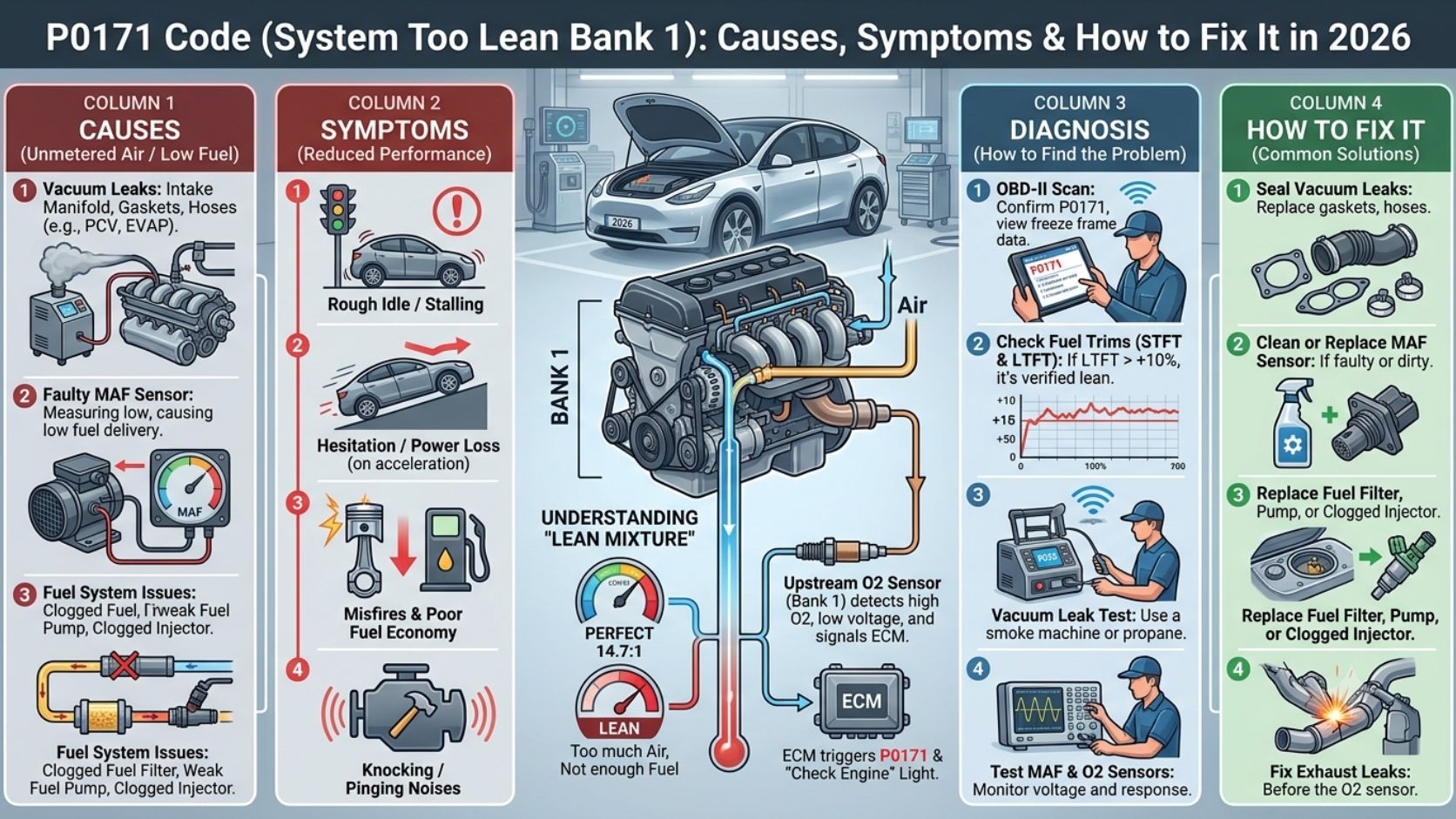

Don’t panic. This is in fact one of the most common U.S. diagnostic codes. It is in fact the second most common check engine light fault found in the country. It’s a problem for millions of people across all makes and models every year.
But what does the P0171 code mean? It means “System Too Lean (Bank 1)”. Your engine has too much air and not enough fuel! That disrupts the combustion process — and your car’s computer detects immediately.
This guide will enlighten you about that. You will discover what is causing it and what symptoms are indicative and how much it costs to correct. Let’s get into it.
So what does the P0171 code really mean?
An exact balance of fuel and air is required for your engine to function. 14.7:1 is the optimal fuel to air ratio. The engine will run “lean” if it is too high toward the air.
When the powertrain control module (PCM) notices this imbalance on the engine’s side with the first cylinder (Bank 1), it transmits the p0171 code. The PCM injects additional gasoline in an effort to compensate for this. But when it reaches its limit and still can’t fix the ratio, it stores the Po171 code and turns on the check engine light.
With inline 4-cylinder engines, there’s only one bank — and, therefore, P0171 will always refer to the entire engine. Bank 1 is located on the side of the engine opposite cylinder #1 for the V6 and V8 engines. If you’re unsure, consult the owner’s handbook for your car as it may vary depending on the manufacturer.
Common Symptoms of the P0171 Code
The p0171 engine code shows up in different ways depending on how bad the lean condition is. Here’s what most drivers actually notice:
- Check engine light — the first and most obvious sign
- Rough idle — the engine shakes or stumbles at a stop
- Hesitation during acceleration — the car feels sluggish when you press the gas
- Engine misfires — you feel jerking or sputtering, especially under load
- Poor fuel economy — you’re filling up more often than usual
- Stalling — the engine shuts off, especially when warm
Some drivers also notice a slight hissing sound from under the hood. That’s often a vacuum leak — and it’s one of the most common causes of this new code.
Top Causes of the P0171 Code
1. Vacuum Leak (Most Common)
Vacuum leaks cause roughly 40% of all P0171 cases. As rubber hoses age, they crack. Intake manifold gaskets wear out. PCV hoses split. When that happens, unmetered air sneaks into the intake system past the MAF sensor. The computer doesn’t account for it and the mixture goes lean.
The intake boot between the air filter box and throttle body is the single most common culprit. Check it first. A cracked boot often costs just $20–$60 to replace.
2. Dirty or Failing MAF Sensor
The amount of air that enters the engine is measured by the Mass Airflow (MAF) sensor. It provides inaccurate readings to the computer when it becomes covered in dust or oil from an over-oiled air filter. The PCM then injects too little fuel — and the p0171 code appears.
The good news? Cleaning the MAF sensor often fixes the problem. A can of MAF cleaner costs around $8–$12. It takes about 10 minutes and requires no special tools.
3. Fuel System Problems
Fuel supply is decreased by a malfunctioning fuel pump, a blocked fuel filter, or unclean fuel injectors. The engine runs lean when it doesn’t get enough gasoline. This type of lean condition tends to get worse under load — like when you accelerate hard or climb a hill.
Fuel system repairs cost more than a vacuum fix. Expect to pay $150–$500 depending on what needs replacing.
4. Exhaust Leak Near the Oxygen Sensor
An exhaust leak before the upstream O2 sensor pulls outside air into the exhaust stream. The sensor reads that extra oxygen as a lean condition — even when the actual fuel mixture is fine. This one trips up a lot of DIYers who replace sensors unnecessarily.
5. Faulty Oxygen Sensor
A slow or lazy O2 sensor sends inaccurate data to the PCM. The computer reacts by pulling fuel — which creates the lean condition itself. Although it is less frequent as a stand-alone cause, high-mileage cars do experience this.
How to Diagnose the P0171 Code Step by Step
Here’s how a real mechanic approaches this — in order:
Step 1 – Begin with a scan of all codes. Check for misfire codes (P0300–P0312) and P0174. P0171 and P0174 indicate that the problem exists in both banks, which is probably a MAF sensor or fuel pressure problem. The P0171 code is the only one that points to a specific problem on Bank 1.
Step 2 –Inspect gas cap. When a loose or fractured gas cap is found, which occasionally occurs in combination with P0171, EVAP codes will also show up. Try again after tightening it and clearing the code.
Step 3: Check intake boot and vacuum hoses. Check for cracks, splits at clamp edges and missing lines. Light a flashlight and start at the air filter box and work your way towards the throttle body.
Step 4: Clean MAF Sensor. Wash with approved MAF cleaner. Allow to dry before reinstalling. Don’t touch the wire element with your fingers.
Step 5 — Perform a smoke test. A smoke machine pumps pressurized smoke into the sealed intake. Any leak reveals itself visually. This is the fastest and most accurate way to find hidden vacuum leaks. Shops that use smoke tests catch leaks in minutes that visual inspection would miss entirely.
Step 6 — Check fuel pressure. Use a fuel pressure gauge under snap throttle. Pressure should stay within spec — typically 45–60 PSI. If it drops under load, the fuel pump or filter is suspect.
P0171 Repair Costs: What to Expect
| Repair Type | DIY Cost | Professional Cost |
| Gas cap replacement | $10–$20 | $10–$30 |
| MAF sensor cleaning | $8–$12 | $50–$100 |
| Vacuum hose replacement | $10–$40 | $75–$150 |
| MAF sensor replacement | $50–$150 | $150–$300 |
| Intake manifold gasket | $20–$60 | $200–$500 |
| Fuel injector cleaning | $15–$30 | $100–$200 |
| Fuel pump replacement | $100–$300 | $300–$600 |
For instance, a Los Angeles resident with a 2019 Chevy Silverado received a P0171 for rough idling. A fractured vacuum hose was the diagnosis. Total repair cost — $75. Back to normal the same day.
Another example: A 2020 Chevy Equinox in Chicago showed poor fuel economy and a check engine light. The MAF sensor was dirty. After a $15 cleaning, the SUV ran perfectly again.
The majority of P0171 problems may be resolved for less than $200 if proper diagnosis is made prior to part replacement.
Can You Drive with a P0171 Code?
Short answer — yes, briefly. The car stays drivable for short trips under 10 miles.
But don’t ignore it. A sustained lean condition creates real problems over time. The lean burn damages spark plugs. It overheats the catalytic converter. Misfires develop, which send unburned fuel into the exhaust — and that accelerates catalytic converter failure fast. A new catalytic converter runs $800–$2,500. That’s a much bigger bill than fixing the original lean condition.
Bottom line — address the p0171 code and area codes within a few days of it appearing.
Will P0171 Fail an Emissions Test?
Yes. The check engine light alone is an automatic emissions test failure in most U.S. states. The lean condition itself also means your vehicle isn’t meeting emissions standards. Fix the code before scheduling any smog check.
FAQ: P0171 Code Questions Answered
What does p0171 mean?
The engine is operating “too lean” on the “Bank 1” according to the p0171 code. Either too much air or not enough gasoline is going into Bank 1’s engine. The PCM determines the faulty situation and keeps the code in memory.
Which of these is the most frequent p0171?
Approximately 40% of P0171 repairs are remedied with the repair of the vacuum leaks. If the intake boot is cracked or the intake manifold has a leaky gasket, then air is flowing into the intake manifold without going through the MAF sensor. Check there first.
Could I do the repair on my own for P0171?
Yes, in many cases. The MAF sensor, which costs about $8, a broken vacuum hose (compared to $15 – $40) and a loose gas cap are three repairs that are easily done at home. More expertise is required for fuel pump or injector problems.
Will p0171 disappear on its own?
No. This is due to the fact that treating the fundamental issue must come first. After the repair is complete, run all of the monitors in a driving cycle or use an OBD2 code reader to clear the codes.
What’s the difference between p0171 and p0174?
P0171 is Bank 1 lean. P0174 is Bank 2 lean. Combined, these codes most commonly indicate a single problem – dirty MAF sensor or low fuel pressure – affecting the entire engine.
Conclusion
The p0171 code, as all fault codes are, is daunting but is one of the easier to fix codes you will come across when dealing with an engine code. For the easy steps: Make sure that the gas cap is in place, clean the MAF sensor and look for any cracks in the intake boot. That’s usually the only thing necessary.
If the above steps don’t clear the code, proceed with a smoke test and fuel pressure check. Systematically work through the diagnosis without spending any money on parts.
Resolve the P0171 engine code in the early stages of the work. It will help out your engine and your wallet!
